


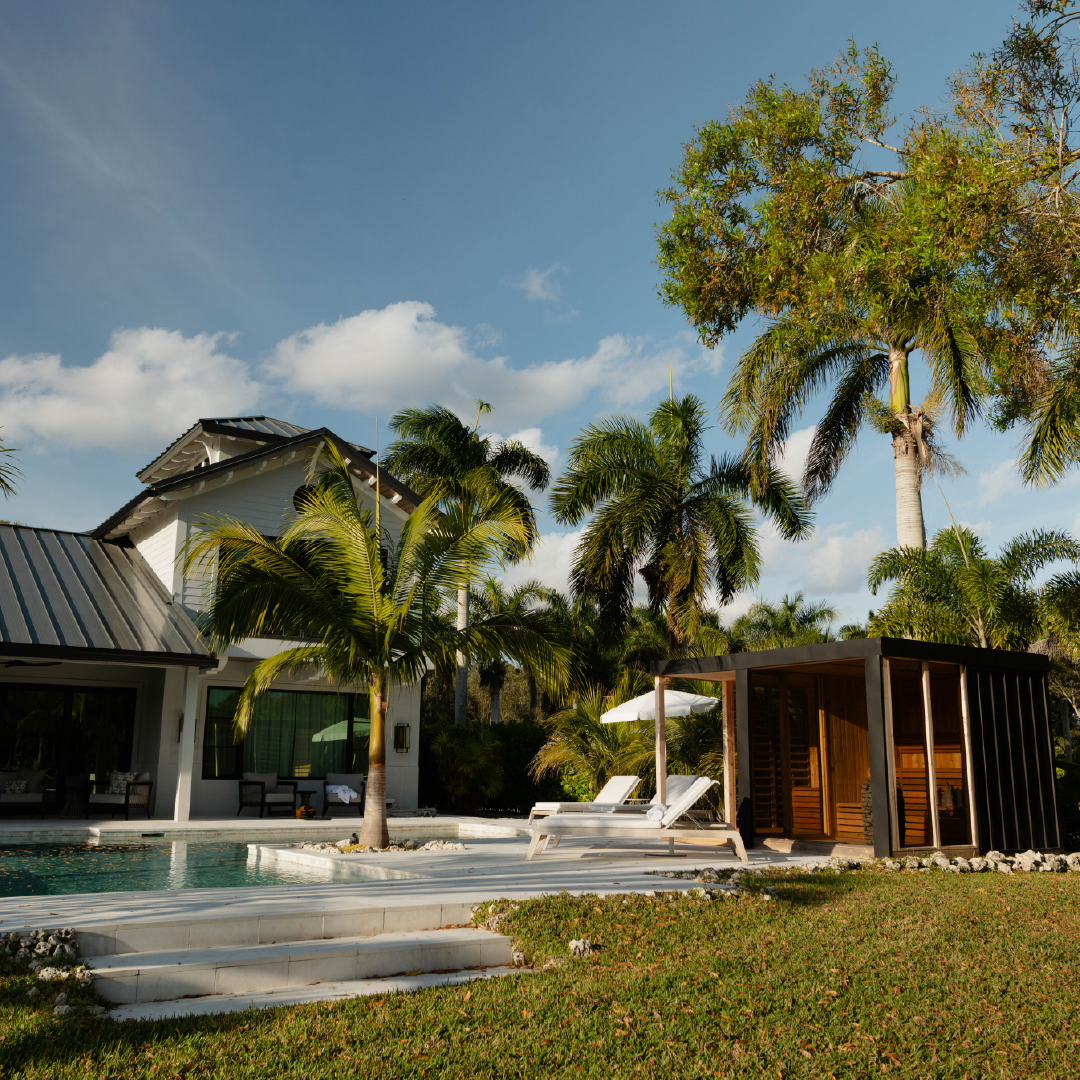
There is a moment — just after the cedar door swings closed, just before the first wave of heat settles across your shoulders — when the rest of the world falls away entirely. The air is warm and alive with the quiet scent of aged western red cedar. Outside, it may be January in Ontario, snow pressing silently against the glass; or a golden August evening in the Muskoka hills, the lake barely visible through the pines. None of that exists here. In a home sauna crafted with intention, what exists is only warmth, stillness, and the slow, restorative unwinding of everything you've been carrying. This is what it means to invest in a sauna of your own.
Explore our full sauna collection and discover the model that was made for your life.
Why a Home Sauna Is the Ultimate Wellness Investment
For centuries, the sauna has occupied a singular place in Nordic culture — not as a luxury, but as a necessity. A place for physical recovery, for honest conversation, for the kind of silence that restores rather than empties. Today, the science has caught up with what tradition always knew. Regular sauna use is associated with proven health benefits: improved cardiovascular function, accelerated muscle recovery, deeper sleep, and a measurable reduction in cortisol. The ritual, it turns out, is medicine.
A home sauna elevates this further. There are no schedules, no shared benches, no fluorescent corridors leading to a gym you never quite feel at home in. Your sauna is available at dawn, at midnight, after a long day on the water or a hard morning on the slopes. It is a permanent fixture in your daily wellness practice — and, increasingly, a defining feature of the discerning Canadian home.
In Ontario's cottage country and across the landscapes of British Columbia and Alberta, the home sauna has become something more than amenity. It is an expression of how one chooses to live.
Choosing Your Sauna Style
The first decision — and in many ways the most pleasurable one — is choosing the form your sauna will take. Each style carries its own character, its own relationship to landscape and interior. Our outdoor saunas and indoor models each offer distinct experiences worth understanding before you begin.
| Style | Best For | Strengths | Considerations |
|---|---|---|---|
| Barrel Sauna | Outdoor settings, cottages, lakefront properties | Exceptional heat circulation due to curved geometry; iconic aesthetic; faster heat-up time; designed to withstand harsh Canadian winters | Fixed outdoor footprint; requires a level foundation |
| Cabin / Nordic Sauna | Year-round outdoor use, larger properties | Spacious interiors; change room options; architectural presence; ideal for extended sessions | Larger installation footprint; higher entry investment |
| Cedar Cube | Modern homes, urban properties, patios | Contemporary silhouette; flexible placement; striking visual statement | Compact interior; best suited for one to two bathers |
| Indoor Sauna Room | Basements, spa rooms, wellness suites | Year-round access regardless of weather; integrates seamlessly with home design; highly customizable | Requires proper ventilation and waterproofing; permanent installation |
Our cedar barrel saunas remain among our most beloved — a silhouette instantly recognizable on a dock at dusk, steam rising quietly into cold air. For those drawn to a more architectural interior presence, our indoor cedar saunas offer a seamless fusion of contemporary design and traditional heat.
Indoor vs. Outdoor — What's Right for Your Property
The choice between an indoor and outdoor installation is rarely purely practical — it is also a question of experience. An outdoor sauna, particularly in the Canadian landscape, offers something irreplaceable: the contrast of stepping from searing heat into cold night air, the walk across a moonlit deck, the plunge into a lake or cold tub. This thermal journey — heat, cold, rest — is the full sauna ritual as it was meant to be practised.
Indoor installations bring their own refinement. Situated within a dedicated wellness room, basement spa, or master bath suite, an indoor sauna becomes a seamless part of daily life — accessible in any season, in any weather. For Ontario's deep winters or the dramatic shoulder seasons of British Columbia and Alberta, this accessibility has real value.
Consider the following when assessing your property:
- Outdoor saunas require a stable, level foundation (concrete pad, gravel base, or treated deck) and access to a power source. Most also benefit from proximity to a cold plunge or natural water feature.
- Indoor saunas require adequate ceiling height (minimum 7 feet), proper ventilation, a moisture barrier, and access to appropriate electrical circuits. A dedicated wellness room or renovated basement space works beautifully.
- Both options should be situated with privacy and atmosphere in mind — your sauna is a sanctuary, and its setting should honour that.
Understanding Heaters: Electric, Wood-Burning & Infrared
The heater is the heart of your sauna. Its selection shapes not only the temperature of your session but its entire quality — the texture of the heat, the ritual of preparation, the depth of the experience.
Electric heaters
are the most versatile and widely used. They heat a sauna to temperature in 30 to 45 minutes, allow precise control via digital or analog controls, and require only an appropriate electrical circuit. For urban properties and indoor installations, they are the natural choice. Our The Superior Hydra Sauna exemplifies what a premium electric heater can deliver — consistent, enveloping heat with minimal maintenance.
Wood-burning heaters
are the traditional choice, and for good reason. There is a meditative quality to building a fire, tending it, and waiting as the sauna slowly reaches temperature. Wood-burning saunas produce a particularly soft, humid heat — deeply beloved by purists. They are ideally suited to remote cottage properties, off-grid cabins, or anyone who values ceremony as part of their wellness ritual. The The Neptune Sauna pairs beautifully with a classic wood-burning stove for those seeking an authentic Nordic experience.
Infrared heaters
operate on a different principle entirely, warming the body directly through radiant heat rather than heating the ambient air. Sessions typically run at lower temperatures (50–60°C versus the 80–100°C of a traditional sauna) and are particularly well-regarded for muscle recovery, joint relief, and accessibility for those who find high-heat environments challenging. Infrared models heat up in as little as 15 minutes.
Sizing, Capacity & Electrical Requirements
Choosing the right size is a matter of both immediate comfort and long-term satisfaction. A sauna that feels appropriately intimate for two may feel confining for a family of four; a generous cabin sauna may overwhelm a compact urban garden. Consider not only current use but how you envision the space in five years.
General sizing guidance:
- 1–2 persons: 4' x 4' to 4' x 6' interior
- 2–4 persons: 5' x 7' to 6' x 8' interior
- 4–6 persons: 8' x 10' and above; or a dedicated cabin-style structure
Electrical requirements
vary by heater size and model:
- Small electric heaters (3–6 kW): typically 240V / 20–30A
- Larger heaters (8–12 kW): typically 240V / 40–60A
- Wood-burning models: no electrical requirement for the heater itself, though lighting and accessories will require a standard circuit
- Infrared models: many operate on standard 120V household circuits, making them the simplest to install
We recommend consulting with a licensed electrician prior to installation. Our team is also available to advise — speak with our sauna specialists and we'll help ensure your electrical setup is correct from the outset.
The Muskoka Cedar Difference
Not all cedar is equal. The western red cedar we source for every Muskoka Sauna Co. structure is harvested from the old-growth forests of British Columbia — a wood renowned for its dimensional stability, its natural resistance to moisture and decay, and the extraordinary depth of its aromatic character. When you step into a Muskoka sauna for the first time, the scent alone communicates something that cannot be manufactured: this is a material that has taken decades to become what it is.
Our artisan cedar is kiln-dried, hand-selected, and precision-milled to ensure uniformity of grain and surface — details that matter not only aesthetically but structurally. In Canada's climate extremes, from the freeze-thaw cycles of Ontario winters to the wet coastal seasons of British Columbia, a sauna must be built to endure. Every joint, every board, every fastener in a Muskoka sauna is chosen with that reality in mind.
This is Canadian-crafted quality in the fullest sense: designed for the landscape it inhabits, built to last across generations. Browse our Auroom sauna collection for a curated selection of our finest European-designed, cedar-built models — each one a study in the intersection of function and beauty.
Our The Hudson Sauna and The Orion Sauna represent two expressions of this philosophy — the former a generous, family-scaled outdoor sanctuary; the latter a precise, architecturally refined indoor statement.
Pairing Your Sauna with a Cold Plunge
The sauna alone is transformative. The sauna paired with a cold plunge is something else entirely.
The practice of alternating between heat and cold — known as contrast therapy — has deep roots in Scandinavian tradition and is now among the most studied protocols in sports science and longevity research. A session of 15–20 minutes in the sauna, followed by a 2–3 minute cold immersion, followed by rest, then repeated: the physiological effects are profound. Circulation surges. Inflammation subsides. Endorphins rise. The nervous system is recalibrated in a way that no single modality can replicate.
At Muskoka Sauna Co., our cold plunge collection has been curated to complement our saunas in both function and form. Whether positioned on a lakeside deck, in a backyard wellness space, or within a dedicated indoor spa suite, a cold plunge transforms your sauna ritual into a complete therapeutic practice — one that elite athletes, biohackers, and thoughtful wellness practitioners have embraced as a cornerstone of daily health.
Investment & Installation Timeline
A Muskoka sauna is a meaningful investment — one that appreciates in daily use, in property value, and in the quality of life it enables. Understanding the landscape of investment helps set clear expectations.
Investment ranges (CAD, approximate):
- Entry-level indoor infrared models: from $3,500–$6,000
- Premium barrel saunas: from $7,000–$15,000
- Cabin and Nordic-style outdoor saunas: from $14,000–$35,000+
- Custom indoor spa installations: from $20,000 and above, depending on scope
Installation timeline:
- Site preparation (foundation, electrical rough-in): 1–2 weeks depending on complexity
- Sauna delivery and assembly: typically 1–3 days for modular structures; 1–2 weeks for custom builds
- Total from order to first session: 4–10 weeks on average, depending on model and custom specifications
Our team coordinates delivery across Ontario, British Columbia, Alberta, and all major Canadian provinces. Every Muskoka sauna arrives with complete installation documentation, and our specialists are available throughout the process.
Every Muskoka sauna begins with a conversation. Request your complimentary quote and take the first step toward a life of daily ritual.
Ready to Begin?
The decision to install a home sauna is, at its core, a decision about how you want to live. It is a commitment to recovery, to stillness, to the kind of deliberate wellness that cannot be rushed or outsourced. It is, for many of our clients, one of the most quietly significant investments they have ever made in their home — and in themselves.
At Muskoka Sauna Co., we have guided hundreds of Canadians through this process: from the first question about sizing to the moment the door closes for the first time and the heat begins to rise. Our expertise is not incidental — it is the foundation of everything we make and every recommendation we offer.
Ready to design your personal sanctuary? Speak with our sauna specialists — we'll guide you through every detail, from sizing to heater selection, foundation requirements to finishing touches. There is no obligation, only the beginning of a conversation that could change your daily life.
When you're ready to explore, our full sauna collection is waiting.
Frequently Asked Questions
How long does a home sauna take to heat up?
Electric saunas typically reach optimal temperature (75–95°C) in 30 to 45 minutes. Infrared models are ready in 15 to 20 minutes. Wood-burning saunas require 45 to 90 minutes depending on the size of the space and the quality of the fire. Many of our clients build the heating ritual — lighting the fire, or switching on the heater as part of a morning or evening routine — into the experience itself.
Do I need a building permit for a home sauna in Canada?
Requirements vary by municipality and province. Freestanding outdoor saunas below a certain square footage often do not require a permit, but attached structures and indoor installations typically do. We recommend confirming with your local municipality before installation. Our team can advise on what to expect in Ontario, British Columbia, and Alberta specifically.
What is the best wood for a sauna?
Canadian western red cedar is widely regarded as the finest sauna wood available — prized for its natural moisture resistance, dimensional stability, and aromatic richness. It remains cool to the touch even at high temperatures and develops a beautiful patina over time. All Muskoka Sauna Co. structures are crafted from premium, kiln-dried western red cedar sourced from British Columbia.
Can a sauna be used year-round in Canadian winters?
Absolutely — and many would argue winter is the finest season for it. Our outdoor saunas are engineered specifically for Canada's climate extremes, with robust insulation, weather-resistant joinery, and cedar construction that handles freeze-thaw cycles without compromise. Stepping from a 90°C sauna into a February evening is, for many, the defining experience of owning one.
How much does it cost to run a home sauna?
Operating costs depend on heater type, session frequency, and local hydro rates. A typical 6 kW electric sauna running for one hour consumes approximately 4–5 kWh of electricity — comparable to running a standard clothes dryer. At average Canadian electricity rates, a daily session adds roughly $15–$30 per month to your hydro bill. Infrared models are typically more energy-efficient; wood-burning models depend on fuel costs.
What maintenance does a cedar sauna require?
Very little, when built well. Cedar is naturally resistant to moisture, bacteria, and decay — it does not require staining, painting, or sealing on interior surfaces. A light sanding every few years refreshes the surface and renews the aromatic quality of the wood. Exterior surfaces on outdoor saunas benefit from an annual application of a UV-protective cedar oil. Heater maintenance is minimal: an annual inspection and stone replacement as needed.


